
This complete study guide covers the Making of the Indian Constitution for SSC CGL, CHSL, MTS and other government exams with detailed notes, timeline and MCQs.
India adopted its Constitution on 26 November 1949. However, it came into effect on 26 January 1950. The leaders of India did not prepare the Constitution in a single day; it was the result of years of discussions, debates, and careful drafting by some of the greatest leaders of the country.
In this article, you will learn the complete process of the making of the Indian Constitution along with important facts and practice MCQs for SSC preparation.
Understanding the Concept of a Constitution
A Constitution lays down the fundamental principles and rules according to which a country is governed. For SSC exams, understanding this concept is very important in Indian Polity. It defines the structure of government, the distribution of powers, and the rights of citizens. In simple words, a Constitution acts as the supreme law of the land.
Historically the modern tradition of written Constitutions began in the United States in 1787. After gaining independence on 4 July 1776, the USA adopted a written Constitution, which later became a model for many democratic nations.
All democratic countries have a Constitution. However, every country that has a Constitution is not necessarily democratic.
The Indian Constitution is often described as partly rigid and partly flexible. Some provisions can be amended easily, while others require a special procedure. This unique feature makes it suitable for a diverse country like India.
This background is important to understand the Making of the Indian Constitution for SSC preparation.
Other Forms of Government
To better understand constitutional systems, it is helpful to learn about different forms of government often asked in SSC examinations.
1. Communist Government
In a communist system, the means of production and major resources are controlled by the state. Countries such as China, North Korea, Cuba, and Vietnam follow communist principles.
2. Monarchical Government
In a monarchical system, power is concentrated in the hands of a single ruler — a king or a queen. In some countries, the monarch has absolute powers, while in others, the powers are limited by law.
3. Totalitarian Government
In a totalitarian system, the state exercises, the state exercises total control over the lives of citizens. Individual freedoms are very limited, and political opposition is usually suppressed.
4. Oligarchic Government
In an oligarchic system, power is held by a small group of people. Control may be based on wealth, family ties, military power, or political influence
SSC Quick Revision Points
The following points are important for quick SSC revision:
| Constitution = Supreme law of the land |
| USA Constitution: 1787 |
| Independence of USA: 4 July 1776 |
| Indian Constitution: Partly rigid, partly flexible |
Demand for a Constituent Assembly
Nehru Report (1928)
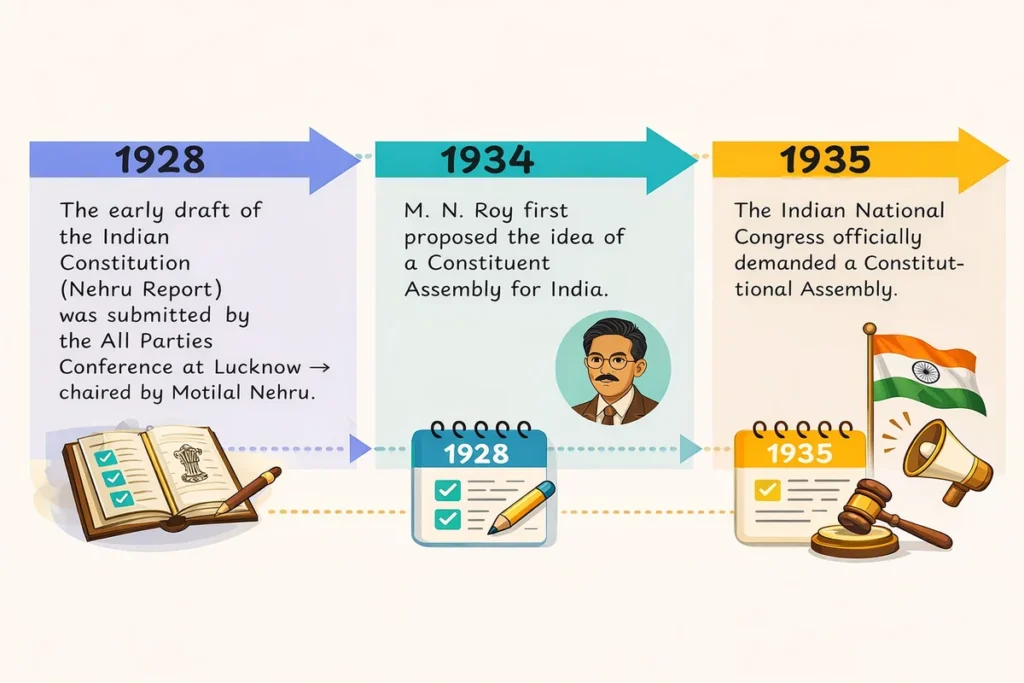
In 1928, leaders prepared an early draft of the Indian Constitution, which became known as the Nehru. This draft is known as the Nehru Report. It was submitted at the All-Parties Conference held in Lucknow. Motilal Nehru chaired the conference.
However, the British government did not officially accept this report, but it became an important step towards constitutional development in India.
M. N. Roy’s Proposal (1934)
In 1934, M. N. Roy became the first person to officially propose the idea of a Constituent Assembly for India. He believed that Indians themselves should prepare their Constitution, not the British government.
This idea later became very important in the freedom movement.
Congress Demand (1935)
Later, in 1935, the Indian National Congress officially demanded the formation of a Constituent Assembly. The demand was that members of the Assembly should be elected by the people of India.
This demand gradually gained support and ultimately led to the formation of the Constituent Assembly in 1946 under the Cabinet Mission Plan.
British Proposals Before Independence
1. August Offer (1940)
The August Offer was announced by British Viceroy Lord Linlithgow in 1940 during World War II. The main objective of this proposal was to secure Indian support for the British war efforts by promising constitutional reforms after the war.
- Proposed by Lord Linlithgow
- During World War II
- Promised Dominion Status to India
⭐ SSC Exam Tip
The August Offer (1940) is important for SSC exams because it was the first official British proposal promising Dominion Status to India.
What is Dominion Status?
Dominion Status refers to a political arrangement in which a country becomes self-governing but still remains a part of the British Empire. Such countries could manage their internal administration independently, while the British Crown continued to remain the symbolic head.
Historically, the term “Dominion” was used for countries like Canada and Australia before they became fully independent nations.
Indian leaders were not satisfied with this proposal because they demanded complete independence instead of limited self-government.
Dominion Status is dead as a doornail.
By Jawaharlal Nehru
2. Cripps Mission (1942)
The British government sent the Cripps Mission to India in 1942 under the leadership of Sir Stafford Cripps during World War II. The main aim of the mission was to gain Indian support for the war by offering constitutional reforms after its completion. The proposal promised Dominion Status to India and also suggested the formation of a Constituent Assembly to draft a new Constitution after the war. However, Indian leaders rejected the plan because it did not grant immediate self-government and allowed provinces the option to separate from the Indian Union.
- Led by Sir Stafford Cripps
- Sent during World War II (1942)
- Promised Dominion Status after the war
- Proposed formation of a Constituent Assembly
- Rejected by Indian National Congress and other leaders
⭐ SSC Exam Tip
Cripps Mission (1942) is important for SSC exams because it was the first British proposal that clearly mentioned the creation of a Constituent Assembly for India.
3. Wavell Plan (1945)
British Viceroy Lord Wavell introduced the Wavell Plan in 1945 to resolve the political deadlock between Indian leaders and the British government. The proposal aimed to reconstitute the Viceroy’s Executive Council by including equal representation of Hindus and Muslims. A conference was held in Shimla to discuss the plan, which is why it is also known as the Shimla Conference. However, The plan ultimately failed because Indian political parties could not reach an agreement on representation.
- Proposed by Lord Wavell in 1945
- Also known as the Shimla Conference
- Suggested reconstitution of the Executive Council
- Equal representation for Hindus and Muslims
- Failed due to political disagreements
⭐ SSC Exam Tip
The Wavell Plan (1945) is important because it attempted to form an interim government before independence but failed due to disagreements between political parties.
4. Cabinet Mission Plan (1946)
The British government sent the Cabinet Mission to India in 1946 to find a political solution and transfer power peacefully to Indian leaders. The mission included three British cabinet members — Lord Pethick-Lawrence, Sir Stafford Cripps, and A. V. Alexander. Its main objective was to create a framework for an independent India and to form a Constituent Assembly responsible for drafting the Constitution. Unlike earlier proposals, major political parties accepted this plan, which ultimately led to the formation of the Constituent Assembly in 1946.
- Sent by the British government in 1946
- Members: Pethick-Lawrence, Stafford Cripps, A. V. Alexander
- Proposed formation of Constituent Assembly
- Aimed at the peaceful transfer of power
- Accepted by major political parties
⭐ SSC Exam Tip
The Cabinet Mission Plan (1946) is the most important proposal because the Constituent Assembly of India was formed according to this plan, and it was the only plan accepted by both the Indian National Congress and the Muslim League.
| Proposal | Year | Main Idea | Result |
|---|---|---|---|
| August Offer | 1940 | Dominion Status | Rejected |
| Cripps Mission | 1942 | Constitution after war | Rejected |
| Wavell Plan | 1945 | Interim Government | Rejected |
| Cabinet Mission | 1946 | Constituent Assembly | Accepted |
Formation of the Constituent Assembly (1946)
After the acceptance of the Cabinet Mission Plan, the Constituent Assembly of India was formed in 1946 to draft a Constitution for independent India. However, the public did not directly elect the members of the Assembly; instead, provincial legislative assemblies chose them indirectly.
In addition, the Assembly included representatives from both British Indian provinces and princely states to ensure participation from different regions of the country.
Total Strength of the Constituent Assembly
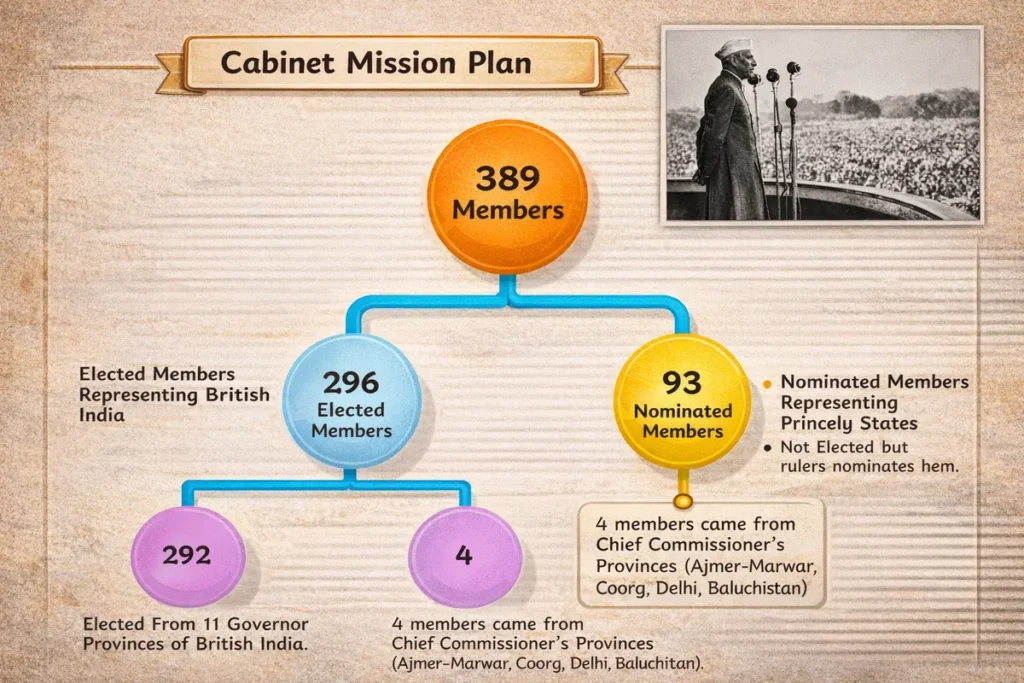
Initially, the Constituent Assembly consisted of 389 members who represented different parts of India and discussed the drafting of the Constitution.
Composition of Members
Overall, out of the total 389 members:
- 296 members represented British India.
- 93 members represented the Princely States.
As a result, this structure ensured representation from both directly governed British territories and semi-autonomous princely regions.
Representation from Provinces
Among the representatives of British India, the distribution of seats was as follows:
- 292 members were elected from the Governors’ Provinces.
- 4 members came from Chief Commissioner’s Provinces such as Delhi, Ajmer-Marwar, Coorg, and Baluchistan.
Therefore, provincial legislative assemblies elected these members indirectly using proportional representation.
Representation of Princely States
In contrast, the people did not elect representatives from the princely states. Instead, the rulers of these states nominated them. Consequently, this system reflected the political structure of princely India during British rule.
⭐ SSC Quick Revision Points
For quick revision, remember the following important facts:
- Constituent Assembly formed: 1946
- Based on: Cabinet Mission Plan
- Total members: 389
- British India: 296
- Princely States: 93
- Governors’ Provinces: 292
- Chief Commissioner Provinces: 4
Election Process and Interim Government (1946)
After the Cabinet Mission Plan was accepted, the authorities conducted elections in 1946 to select members of the Constituent Assembly. As a result, the process ensured representation of different communities and regions of India.
Seat Allocation and Election Method
Initially, seats in the Constituent Assembly were allocated among British Indian provinces based on population. Furthermore, representation was divided among three major communities — General, Muslim, and Sikh.
Provincial legislative assemblies elected members indirectly using the system of Proportional Representation through Single Transferable Vote. Consequently, this method ensured fair representation of different political groups.
Some members were elected, whereas others were nominated, especially from princely states.
Therefore, the Assembly was partly elected and partly nominated.
Each seat represented approximately one million people.
Election Results of the Constituent Assembly
Later, elections to the Constituent Assembly were held between July and August 1946.
Official election-related information can also be found on the Election Commission of India website.
The election results were as follows:
- Indian National Congress won 208 seats
- Muslim League secured 73 seats
- Independent members won 15 seats
After the partition of India, Muslim League members withdrew, Consequently, the partition reduced the total strength of the Assembly to 299 members.
⭐ SSC Exam Insight
Questions are frequently asked about the election method of the Constituent Assembly — remember Proportional Representation by Single Transferable Vote.
Formation of the Interim Government (1946)
Following the Cabinet Mission Plan, Indian leaders formed the Interim Government of India on 2 September 1946 to manage administration before independence. It functioned as a temporary government until India became independent on 15 August 1947.
The Viceroy headed the Executive Council during this period. Initially, Viscount Wavell served as the Viceroy until February 1947, and later Lord Mountbatten took charge in 1947.
Positions Held by Members of the Interim Government
In addition, the Interim Government included representatives from major political parties and handled important administrative departments before independence.
| Position | Member | Party |
|---|---|---|
| Vice-President of the Executive Council & External Affairs | Jawaharlal Nehru | INC |
| Home Affairs, Information & Broadcasting | Sardar Vallabhbhai Patel | INC |
| Agriculture & Food | Dr. Rajendra Prasad | INC |
| Defence | Baldev Singh | INC |
| Finance | Liaquat Ali Khan | Muslim League |
| Commerce | Ibrahim Ismail Chundrigar | Muslim League |
| Health | Ghazanfar Ali Khan | Muslim League |
| Labour | Jagjivan Ram | INC |
| Law | Jogendra Nath Mandal | Muslim League |
| Education & Arts | C. Rajagopalachari | INC |
| Railways & Communications | Abdur Rab Nishtar | Muslim League |
| Industries & Supplies | John Mathai | INC |
Objective Resolution and Committees of the Constituent Assembly
Objective Resolution (1946)
Jawaharlal Nehru presented the Objective Resolution on 13 December 1946 in the Constituent Assembly. It laid down the fundamental principles and goals that would guide the framing of the Indian Constitution.
Official Constituent Assembly debates and historical records are available at Constitution of India Archive.
Through this resolution, India was declared an independent sovereign republic, emphasizing justice, equality, and freedom for all citizens. After detailed discussions and debates, the Constituent Assembly officially adopted the resolution on 22 January 1947. Later, this resolution became the foundation of the Preamble of the Indian Constitution.
⭐ SSC Exam Tip
- Presented: 13 December 1946
- Adopted: 22 January 1947
- Basis of → Preamble of India
Committees of the Constituent Assembly
To efficiently draft the Constitution, the Constituent Assembly therefore formed several committees to handle different subjects. In total, the Assembly created 8 Major Committees and 13 Minor Committees, each responsible for specific constitutional matters.
Major Committees of the Constituent Assembly
Jawaharlal Nehru
Under his leadership, the following committees were formed:
- Union Powers Committee
- Union Constitution Committee
- States Committee
Sardar Vallabhbhai Patel
Sardar Vallabhbhai Patel headed the following committees:
- Provincial Constitution Committee
- Advisory Committee on Fundamental Rights, Minorities, and Tribal Areas
Dr. Rajendra Prasad
Under his leadership, the following committees were formed:
- Rules of Procedure Committee
- Steering Committee
Dr. B. R. Ambedkar
Similarly, Dr. B. R. Ambedkar chaired the Drafting Committee, which played a key role in preparing the Constitution.
- Drafting Committee
Minor Committees of the Constituent Assembly
In addition, the Constituent Assembly formed several minor committees to handle specific administrative and constitutional responsibilities.
| Committee | Chairman |
|---|---|
| Finance and Staff Committee | Dr. Rajendra Prasad |
| Ad Hoc Committee on the National Flag | Dr. Rajendra Prasad |
| Credentials Committee | Alladi Krishnaswamy Ayyar |
| House Committee | B. Pattabhi Sitaramayya |
| Committee on Chief Commissioners’ Provinces | B. Pattabhi Sitaramayya |
| Order of Business Committee | Dr. K. M. Munshi |
| Committee on Functions of Constituent Assembly | G. V. Mavalankar |
| Ad-hoc Committee on Supreme Court | S. Varadachariar |
| Committee on Citizenship | S. Varadachariar |
| Expert Committee on Financial Provisions | Nalini Ranjan Sarkar |
| Linguistic Provinces Commission | S. K. Dhar |
| Special Committee to Examine Draft Constitution | Jawaharlal Nehru |
| Press Gallery Committee | Usha Nath Sen |
Drafting Committee and Drafting of the Constitution
Formation of the Drafting Committee (1947)
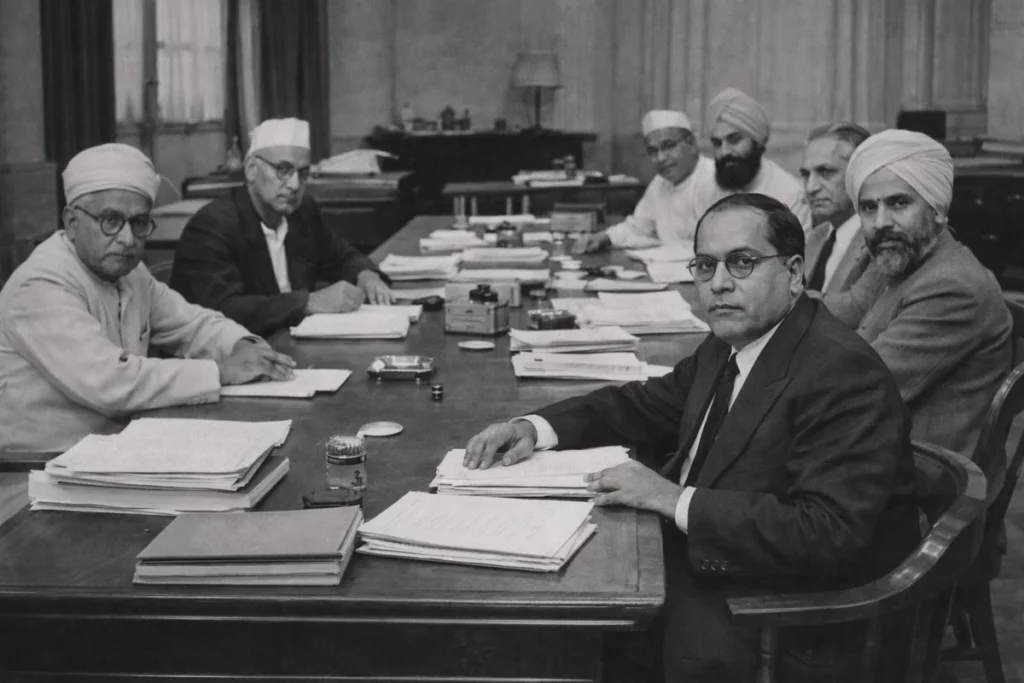
Later, the Constituent Assembly formed the Drafting Committee on 29 August 1947 to prepare the final draft of the Indian Constitution. The committee played a crucial role in converting the ideas and discussions of the Assembly into a legal document.
The committee consisted of seven members, and Dr. B. R. Ambedkar (also known as “Modern Manuh” or “Modern Man”) was appointed as its Chairman. As a result of his significant contribution, he is often called the “Architect of the Indian Constitution.”
Members of the Drafting Committee
The Drafting Committee consisted of the following seven members:
- Dr. B. R. Ambedkar (Chairman)
- Alladi Krishnaswamy Ayyar
- N. Gopalaswami Ayyangar
- Mohammad Saadullah
- B. L. Mitter (later replaced by N. Madhava Rao)
- D. P. Khaitan (later replaced by T. T. Krishnamachari)
- K. M. Munshi
Together, these members were responsible for preparing the draft Constitution of India.
Drafting of the Constitution
The first draft of the Constitution was published on 21 February 1948. It took about eight months for public discussion and suggestions. As a result, citizens and leaders across the country were able to review and comment on the proposed Constitution.
Later, on 4 November 1948, Dr. B. R. Ambedkar presented the final draft before the Constituent Assembly for detailed discussion and debate.
Readings of the Draft Constitution
Before its final adoption, the draft Constitution went through three important readings in the Constituent Assembly:
- First Reading: 4 November – 9 November 1948 (5 days)
- Second Reading: 15 November 1948 – 17 October 1949 (10 months and 3 days)
- Third Reading: Completed on 26 November 1949
As a result, these discussions helped refine and improve the Constitution before its final adoption.
On the first day of the Constituent Assembly, 211 members were present.
⭐ SSC Quick Revision Points
For quick SSC revision, remember the following key facts:
- Drafting Committee formed: 29 August 1947
- Chairman: Dr. B. R. Ambedkar
- Total members: 7
- First draft published: 21 February 1948
- Constitution adopted: 26 November 1949
Adoption, Enforcement and Functions of the Constituent Assembly
Important Sessions of the Constituent Assembly
Overall, the Constituent Assembly held a total of 11 sessions over 165 working days to discuss and draft the Indian Constitution. The entire drafting process took approximately 2 years, 11 months, and 18 days.
- First Session: 9–23 December 1946
- Tenth Session: 6–17 October 1949
- Eleventh Session: 14–26 November 1949 (final session)
During these sessions, members held detailed debates on various provisions of the Constitution.
Adoption of the Constitution
The Constituent Assembly officially adopted the Constitution of India on 26 November 1949. This day is now celebrated as Constitution Day in India.
Initially, the Constitution contained 395 Articles, 8 Schedules, and 22 Parts, along with a Preamble.
Enforcement of the Constitution (Republic Day)
Although the Constituent Assembly adopted the Constitution in November 1949, it came into force on 26 January 1950. This date was chosen to honour the declaration of Purna Swaraj Day, celebrated on 26 January 1930 during the freedom movement.
From this day onward, India became a sovereign democratic republic, and 26 January is celebrated as Republic Day every year.
Key Provisions Enforced on 26 November 1949
Immediately after adoption, some important provisions of the Constitution were implemented:
- Citizenship (Articles 5–9)
- Elections (Articles 324–329)
- Provisional Parliament
Functions of the Constituent Assembly
The Constituent Assembly performed two major functions during the transition to independence:
1. Law-making body:
It worked as the legislative body of India before independence and functioned as the first Parliament of India. G. V. Mavalankar later became the first Speaker of the Lok Sabha.
2. Constitution-making body:
Furthermore, it drafted and finalized the Constitution of India through extensive debates and discussions.
- It functioned as the “First Parliament of India.”
- The Constituent Assembly adopted the National Flag on 22 July 1947.
- The Constituent Assembly adopted the National Anthem, “Jana Gana Mana,” written by Rabindranath Tagore.
- The Constituent Assembly adopted the National Song, “Vande Mataram,” written by Bankim Chandra Chattopadhyay, on 24 January 1950.
- Additionally, it ratified India’s membership of the Commonwealth in May 1949.
Finally, the Constituent Assembly elected Dr. Rajendra Prasad as the first President of India on 26 January 1950.
Working of the Constituent Assembly
- First meeting held on 9 December 1946 (211 Members)
- Temporary President: Dr. Sachchidanand Sinha
- Permanent President: Dr. Rajendra Prasad
- Vice President: H. C. Mukherjee
Important Facts about the Making of the Indian Constitution
Important Constitutional Facts
The making of the Indian Constitution involved several important personalities and historical milestones. Some key facts useful for SSC examinations are listed below:
- Constitutional Advisor: B. N. Rau
- Chief Draftsman of the Constitution: S. N. Mukherjee
- Total members who signed the Constitution: 284 (including 15 women members)
- Secretary of the Constituent Assembly: H. V. R. Iyengar
- India has the largest written Constitution in the world.
- Official language used in drafting: English
- Calligraphers of the Constitution:
- English version: Prem Behari Narain Raizada
- Hindi version: Vasant Krishna Vaidya
Important Female Members of the Constituent Assembly
Several women played an important role in the making of the Indian Constitution and later contributed significantly to Indian public life.
- Rajkumari Amrit Kaur – Independent India’s first Health Minister
- Sucheta Kripalani – First female Chief Minister of Uttar Pradesh
- Sarojini Naidu – First woman Governor of Uttar Pradesh
These notes on the Making of the Indian Constitution for SSC help students revise quickly.
Related SSC Polity Topics
Preamble of Indian Constitution
Features of Indian Constitution